How Ted Geisel Became Dr. Seuss!
Upon returning home, Ted Geisel ventured back to his hometown in Massachusetts in order to make some money to start his life with Helen Palmer. He worked on sending drawings and cartoons off to various magazines in New York with the hopes that they would hire him as an artist or writer (Ford, 2003). He visited the city in the spring, but did not peak enough interest to get a job. Months after he returned home, he learned that The Saturday Evening Post purchased a cartoon of Geisel’s for Twenty-five dollars. This boost of confidence was all he needed to pack his bags and move to New York. His first official job was for Judge magazine as an artist and writer. He made seventy-five dollars a week (Ford, 2003). Since both he and Helen had gotten jobs, they saw it fit to be married shortly after the good news of a career for Geisel. Over the time of his career with Judge magazine, he took two pay cuts and ended up being paid by the sponsors of the magazine with items they sold such as nail clippers and shaving cream (Ford, 2003). Geisel’s career took off in 1940 when he his first drawing for the Flit insecticide was published. The Flit Company hired him immediately to illustrate advertisements that always read “Quick Henry, the Flit!” (Nel, 2004). His salary quickly jumped to twelve thousand dollars yearly, a large amount of money at the time. The Geisels were able to take a few vacations including Japan, Africa, and France. While traveling, Ted’s mother became very sick. It was determined that she had a brain tumor, and because the doctors were unable to remove it, Henrietta Geisel passed away in 1931 (Ford, 2003).
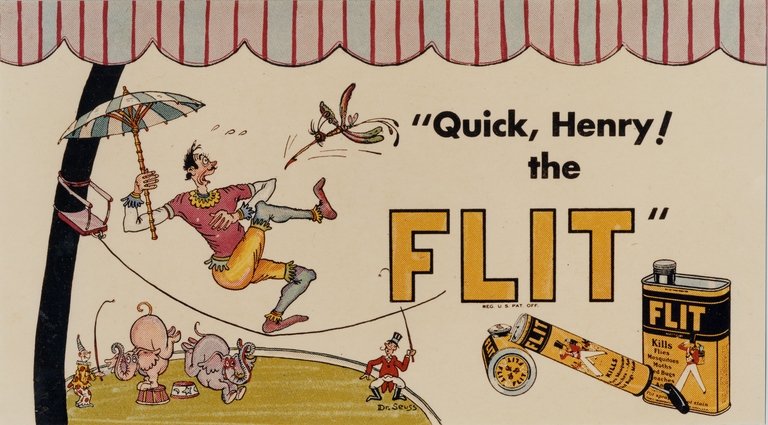
Flit insecticide advertisement illustrated by Dr. Seuss
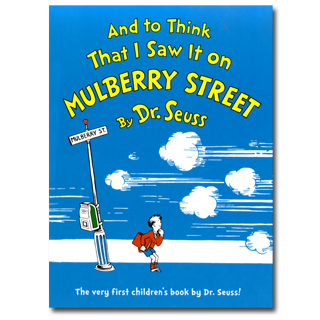
That same year, Geisel drew illustrations for the children’s books Boners and More Boners. He enjoyed drawing in these books, but it was then that he realized he needed to both illustrate and write his own children’s books if he wanted to continue in the field (Ford, 2003). He attempted to write an alphabet book with his drawings but it was not practical to publish because of the colors he used when creating it. His next idea is the one that would launch his career as Dr. Seuss. On the way home from European travels, the idea of And to Think That I Saw It on Mulberry Street formed. It was formulated by Geisel writing verses to the beat of the ship engines. The manuscript took Geisel six months to finish, and once it was finally completed, it was rejected by twenty- seven publishers (Krull, 2004). Vanguard Press eventually published it because of an old Dartmouth classmate worked there. It became a huge success (Krull, 2004). In the beginning, Mulberry Street was rejected by almost thirty publishers, but it soon led to ten thousand copies being sold for one dollar per book, which was expensive at that time. It was the success of this book that began his career as a children’s book author and illustrator. The 500 Hats of Bartholomew Cubbins was written and published soon thereafter (Ford, 2003). This book was dedicated to his imaginary child, Chrysanthemum Pearl. Ted and Helen we unable to have children, and in response to inquiries about why he did not have a family, he always responded with, “You have ‘em, I’ll amuse ‘em” (Ford, 2003). In reality, the Geisels were unable to have children of their own (West, 1996). He came up with the idea for this book because he noticed a stranger wearing a ridiculous hat on the train one morning (Krull, 2004).
 | 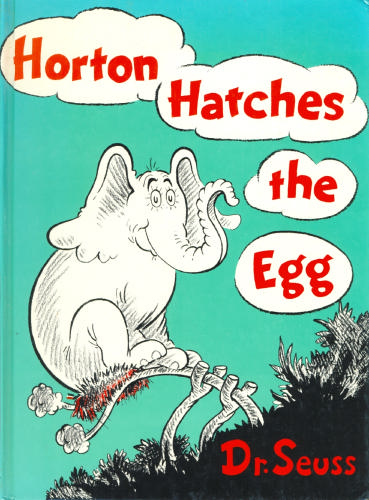 |
Geisel moved from Vanger Publishing to Random House Publishing shortly after his second book. His attempt at writing an adult book, The Seven Lady Godivas was a failure and after writing that and another children’s book, The King’s Stilts, Geisel got the idea for Horton Hatches the Egg, one of the most successful books ever written by Dr. Seuss (Ford, 2003). This idea of Horton came as an accident. A sketch of and elephant Geisel had drawn was blown by the wind from an open window onto another drawing of his of a tree. From that point, Ted had to figure out why the elephant was sitting on the tree. He later decided to make Horton be the caretaker of a bird nest. It was one of Seuss’s few books that hard a moral. This book was a massive success and people dubbed Geisel a Genius. Geisel said, “If I were a genius, why do I have to sweat so hard at my work? I know my stuff all looks like it was rattled off in twenty-three seconds, but every word is a struggle and every sentence is like the pangs of birth” (Morgan, 1995). The success of Horton Hatches the Egg was a happy time in Geisel’s life, but the good times soon came to an end. World War II began in 1939. It was the Allies (The U.S., Great Britain, and France) against the Axis (Germany, Japan, and Italy). Geisel had strong support for the United States, so in 1942, he joined the army. He worked in the Information and Education Division until World War II ended in 1945 (Ford, 2003). This war was said to shape Geisel’s career because when he would draw political cartoons, it made him more willing to confront his readers, regardless of the offensive material (Nel, 2004).
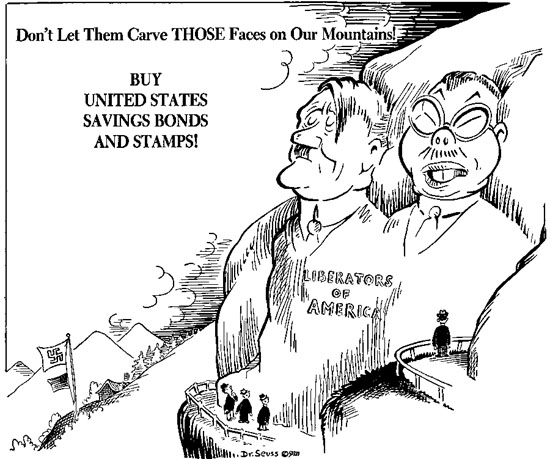 Wartime Cartoon by Theodor Geisel | 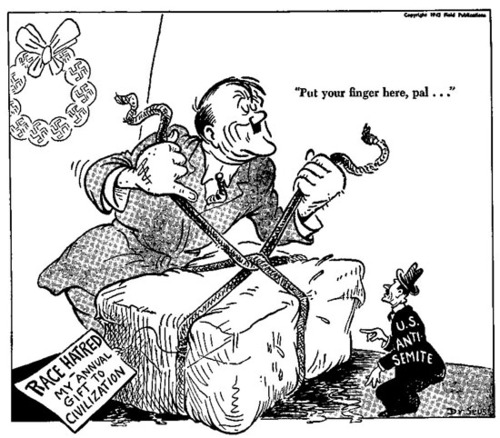 Wartime Cartoon by Theodor Geisel Website by Jordan Miller |
